Father, hear our prayers for the Salvation of the world. 
Grant Mercy to all souls that turned away from You. 
Open their hearts and minds with Your Light. 
Gather Your children from the east and the west, from the north and the south. 
Have mercy O God on those who do not know You. 
Bring them out of darkness into Your Light. 
You are our saving God who leads us in our Salvation. 
Protect us from evil. 
We bless and praise You O Lord; hear our prayers and answer us. 
You, our Savior, are the Hope of all the ends of the Earth and the distant seas. 
May Your way be known upon Earth; among all nations Your salvation. 
We put the world in Your Hands; fill us with Your Love. 
Grant us Peace through Christ, our Lord. Amen.

Saturday, November 3, 2007

Saint Martin de Porres

Today the Church celebrates the optional memorial of St. Martin de Porres, religious, who lived a life of fasting, prayer and penance as a Dominican lay brother.

Martin inherited the features and dark complexion of his mother, and for that reason his noble father eventually turned the boy out of his house. After a turn as a surgeon's apprentice, the young man joined the Dominicans as a laybrother and was put in charge of the infirmary of a friary in Lima. Soon he was caring for the sick of the city and the slaves brought to Peru from Africa — not to mention the animals with which he is often pictured. Martin had the gift of miracles; and although he had no formal training, he was often consulted on theological questions by great churchmen of his day. St. Rose of Lima and Bl. John Massias were among his close friends.
He is unofficially called the patron of social justice.


Friday, November 2, 2007

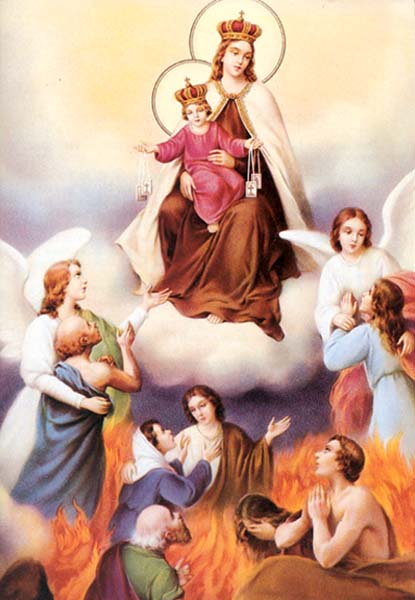
Prayers for the Souls in Purgatory ( pray and light a candle )

O Jesus, Thou suffered and died that all mankind might be saved and brought to eternal happiness.
Hear our pleas for further mercy on the souls of:

(*My Jesus Mercy!)

My dear parents and grandparents,*
My brothers and sisters and other near relatives,*
My godparents and sponsors of Confirmation,*
My spiritual and temporal benefactors,*
My friends and neighbors,*
All for whom love or duty bids me pray,*
Those who have suffered disadvantage or harm through me,*
Those who are especially beloved by Thee,*
Those whose release is near at hand,*
Those who desire most to be united with Thee,*
Those who endure the greatest sufferings’*
Those whose release is most remote,*
Those who are least remembered,*
Those whose are most deserving on account of their services to the Church,*
The rich, who are now the most destitute,*
The mighty, who are now powerless,*
The once spiritually blind, who now see their folly,*
The frivolous, who spent their time in idleness,*
The poor, who did not seek the treasures of heaven,*
The tepid, who devoted little time to prayer,*
The insolent, who neglected to perform good works,*
Those of little faith, who neglected the frequent reception of the Sacraments,*
The habitual sinners, who owe their salvation to a miracle of grace,*
Parents who failed to watch over their children,*
Superiors who were not solicitous for the salvation of those entrusted to them,*
Those who strove for worldly riches and pleasures,*
The worldly-minded, who failed to use their wealth and talents in the service of God,*
Those who witnessed the death of others, but would not think of their own*
Those who did not provide for the life hereafter,*
Those whose sentence is severe because of the great things entrusted to them,*
The popes, kings and rulers,*
The bishops and their counselors,*
My teachers and spiritual advisers,*
The deceased priests of this diocese,*
The priests and religious of the Catholic Church,*
The defenders of the holy faith,*
Those who died on the battlefield,*
Those who fought for their country,*
Those who were buried in the sea,*
Those who died of apoplexy,*
Those who died of heart attacks,*
Those who suffered and died of cancer,*
Those who died suddenly in accidents,*
Those who died without the last rites of the Church,*
Those who shall die within the next twenty-four hours,*
My own poor soul when I shall have to appear before Thy judgement seat.*

Eternal rest grant unto them, O Lord, and let perpetual light shine upon them: Forevermore with Thy Saints, because Thou art gracious.
P. The Lord be with you.
S. And with thy spirit.
May the prayer of Thy suppliant people, we beseech Thee, O Lord, benefit the souls of Thy departed servants and handmaids: that Thou mayest both deliver them from all their sins, and make them to be partakers of Thy redemption. Amen.
Eternal rest grant to them, O Lord, and let perpetual light shine upon them. Amen. May their souls and the souls of all the faithful departed, through the mercy of God, rest in peace. Amen.

All Souls Day


It is during November that the Church meditates on the Communion of Saints, which is the charitable link with the faithful who have already reached heaven (Church Triumphant), the faithful departed who are still expiating their sins in Purgatory (Church Suffering) and of the pilgrim faithful here on earth (Church Militant). "In this wonderful exchange, the holiness of one profits others, well beyond the harm that the sin of one could cause others. Thus recourse to the communion of saints lets the contrite sinner be more promptly and efficaciously purified of the punishments for sin." (Catechism of the Catholic Church, 1475).

The Church, after rejoicing yesterday with those of her children who have entered the glory of heaven, today prays for all those who, in the purifying suffering of purgatory await the day when they will be joined to the company of saints. By virtue of the consoling doctrine of the communion of saints the merits and prayers of each one are able to help all; and the Church is able to join her prayer with that of the saints in heaven and supply what is wanting to the souls in purgatory by means of the Mass, indulgences and the alms and sacrifices of her children.

The Church teaches us that the souls of the just who have left this world with traces of venial sin remain for a time in a place of expiation, where they suffer whatever punishment may be due to their offenses. Even if pardon has been obtained for our sins, satisfaction must be made to God, our Creator, in this world or in the next; for His sanctity has been, as it were, insulted by the self-will of one of His ignoble creatures. The more noble the person offended, the more serious the offense, even according to human laws. It is a dogma of our faith that the suffering souls are relieved by the intercession of the Saints in heaven and by the prayers of the faithful upon earth. To pray for the dead is therefore an act of charity and of piety, certainly obligatory for a Christian who professes to have charity in his heart. We read in Holy Scripture:
“It is a holy and wholesome thought to pray for the dead, that they may be loosed from their sins.” (II Maccabees 12:46)

A partial indulgence, applicable only to the souls in purgatory, can be obtained when the Eternal Rest (Requiem aeternam) is prayed. This is a good prayer to recite especially during the month of November:

Requiem aeternam dona ei (eis), Domine, et lux perpetua luceat ei (eis). Requiescat (-ant) in pace Amen.
Eternal rest grant to them, O Lord, and let perpetual light shine upon them. May the souls of the faithful departed, through the mercy of God, rest in peace. Amen.

Many families add to the "Prayer Before Meals" the second half of the "Eternal Rest" prayer:
Bless us, O Lord, and these thy gifts, Which we are about to receive, from Thy bounty, through Christ, our Lord, Amen. And may the souls of the faithful departed, through the mercy of God, rest in peace. Amen.


Tuesday, October 30, 2007

Pray always

PRAY AND TRUST

Jesus exhorts His disciples to pray always without becoming weary. In order to avoid the weariness that often accompanies the experience of praying always, we do well to consider several dispositions that can assist us in our resolve to follow the Lord’s exhortation.


First, we must realize what prayer is. The saints can assist us in forming a reliable definition. Bl. Teresa of Calcutta used to say that prayer is to the soul what air is to the body. If we take away prayer, the soul suffocates, just as a body deprived of air perishes. St. Teresa of Avila once remarked that prayer is turning to the One who looks upon us with love. The Catechism of the Catholic Church describes prayer as “the raising of one’s mind and heart to God, or the petition of good things from him in accord with his will. It is always the gift of God who comes to encounter man.” In effect, prayer is the personal and living encounter with God. It is a gift from God rooted in love. When we truly love another person, it is difficult to grow weary of him. In fact, we always look forward to our next encounter with him and when we are with him, we do not want to be apart from him because we desire to love and to be loved. Hence, prayer is relational.

Second, we must avoid reducing prayer to mere supplication. Among the general categories of prayer, supplication is the last of the four types of prayer. Adoration, contrition and thanksgiving are the first three forms. Even when we make our petitions, the Catechism’s definition clarifies how this ought to be done. We are to ask good things from God if they be in accord with His will. Many people become discouraged in prayer when they are led to believe that their prayers are not answered. They believe that God does not listen to them because He does not give them what they ask. The reality may be that God does listen to our prayers — it is the answer that we may not like. We can transform the third petition in the Our Father to, “Thy will be done, my way, on earth as it is in heaven.” Thus, petitioning God, we ought to pray for the grace to cooperate with whatever He wants to bestow upon us, regardless of our preferences.Third, we must learn to pray in Faith. With great concern, Jesus asks that when He returns in glory, “Will he find faith on earth?” Faith is not a feeling. Rather, it is an act of the intellect, moved by the will in charity to an objective reality (God) beyond ourselves. The Catechism explains that faith is the first of the three theological virtues, which resides in the intellect, by which we “believe in God and all that he has revealed to us and that the Church proposes for our belief because God is Truth itself. By faith, the human person freely commits himself to God.” Our faith in God must be more than a mere intellectual grasp of doctrine. Rather, it must be a living and personal encounter with the Lord whereby we freely submit our intellect and our will to the One who gazes upon us with love and invites to respond to Him in the same way. Jesus is not seeking persons who can simply make sense of the doctrines of the Church. Instead, He seeks true believers because believers are lovers of God.

With the aforementioned dispositions, we may be able to persevere in prayer, realizing that authentic prayer implies an authentic relationship with the One who loves us more than we love ourselves and who gently moves us to a more frequent and perfect raising of our minds and hearts to Him, who is Love.

( written by Fr. Magat is parochial vicar of Our Lady of Lourdes Parish in Arlington. )

Halloween's positive messages

Among many Christians, there has been concern that things have gotten out of hand. After all, doesn’t Halloween glorify evil? Is it right to send our children out as devils and vampires, or is it better to emphasize the saints, whose nearly forgotten feast day is the reason for Halloween? Hallow is the same word for "holy" that we find in the Lord’s Prayer, and e’en is a contraction of "evening." The word Halloween itself is a shortened form of "All Hallows Eve", the day before All Saints Day. In this Update we’ll consider how Catholics can "redeem" Halloween. This holiday, properly understood and celebrated with all of its fun trappings, can be a way for us to deepen our understanding of our faith. The key to this understanding is close at hand for Catholics in our love of the communion of saints.

Halloween and its back-to-back feast days mean more than talking about our favorite saints who lived in another time, another place. It’s also an opportunity to talk about what’s needed for holiness now (perhaps even martyrdom now, sad to say).
In addition we have a chance to face up to differences that still divide Catholics and Protestants, maybe even a chance to evangelize. "I believe...in the communion of saints," we say every Sunday in the Creed. How many of us know what this doctrine really means?

Do we "worship" or "adore" our beloved saints, as some non-Catholics think? Not at all. We honor them and learn from their example; adoration belongs to God alone. We ask the saints to pray for us the same way we might ask a good friend to pray. A favorite quotation about prayer begins, "Where two or three are gathered together in my name" (Matthew 18:20). The "two or three" aren’t necessarily limited to the living. It’s comforting to have friends always available to pray with you, a whole "cloud of witnesses," in fact! (see Hebrews 12:1).

Halloween also invites us to talk openly about death in a culture that labors mightily to deny it. Seventy-five percent of Americans do not have a valid will, much less a Living Will or an organ donor card. "If I die..." people say, instead of, "when I die." Do we think death is optional? Death is a fact of life. When St. Francis of Assisi lay dying he said, "Welcome, Sister Death," recognizing that death was just another creaturely thing in a world that would one day pass away.

Occasionally we must push the "pause" button in our busy lives to consider our own mortality with all its spiritual and practical consequences. The Church gives us two feasts and the whole month of November to do this.
Halloween is like our Mardi Gras before a very serious Lent. We should be able to laugh at the dark side and dress up in costumes and have parties. Let’s reclaim our heritage with all the story power, creativity and joyous good fun that we can. Let’s use it to help us become the saints we are each called to be.
Halloween is a victory celebration, after all!

( written by by Page McKean Zyromski )

One great song for all passing through


Come, now is the time to worship.
Come, now is the time to give your heart.
Come, just as you are, to worship.
Come, just as you are, before your God.
Come.
One day every tounge will confess
You are God.
One day every knee will bow.
Still the greatest treasure remains for those
Who gladly choose you now.
Come, now is the time to worship.
Come, now is the time to give your heart.
Oh, come.Just as you are to worship.
Come just as you are before your God.
Come.
One day every tounge will confess
You our God
.
One day every knee will bow.
Still the greatest treasure remains for those
who gladly choose you now.
Come, now is the time to worship.
Come, now is the time to give your heart.
Come, just as you are to worship.
Come, just as you are before your God.
Come.
Oh, come.Oh, come.Oh, come.
Worship the Lord.Oh, come.
Come, come, come...

( Phillips Craig and Dean - Come Now Is The Time To Worship )

Sunday, October 28, 2007

How old is your church ?

Well ...

IF YOU ARE a Lutheran, your religion was founded by Martin Luther, an ex-monk of the Catholic Church, in the year 1517.


IF YOU belong to the Church of England, your religion was founded by King Henry VIII in the year 1534, because the Pope would not grant him a divorce with the right to re-marry.


IF YOU ARE a Presbyterian, your religion was founded by John Knox in Scotland in the year 1560.


IF YOU ARE a Congregationalist, your religion was originated by Robert Brown in Holland in 1582.


IF YOU ARE a Baptist, you owe the tenets of your religion to John Smyth, who launched it in Amsterdam in 1605.


IF YOU ARE of the Dutch Reformed church, you recognize Michaelis Jones as founder, because he originated your religion in New York in 1628.


IF YOU ARE a Protestant Episcopalian, your religion was an offshoot of the Church of England founded by Samuel Seabury in the American colonies in the 17th century.


IF YOU ARE a Methodist, your religion was launched by John and Charles Wesley in England in 1744.


IF YOU ARE a Unitarian, Theophilus Lindley founded your church in London in 1774.


IF YOU ARE a Mormon (Latter Day Saints), Joseph Smith started your religion in Palmyra, NY, in 1829.


IF YOU worship with the Salvation Army, your sect began with William Booth in London in 1865.


IF YOU ARE a Christian Scientist, you look to 1879 as the year in which your religion was born and to Mrs. Mary Baker Eddy as its founder.


IF YOU belong to one of the religious organizations known as "Church of the Nazarene," "Pentecostal Gospel," "Holiness Church," "Pilgrim Holiness Church," "Jehovah's Witnesses," your religion is one of the hundreds of new sects founded by men within the past one hundred years.


IF YOU ARE Roman Catholic, you know that your religion was founded in the year 33 by Jesus Christ, the Son of God, and it is still the same Church

28 October , Feast of two great Apostles and Saints : St. Jude and St. Simon

Saint Simon and Saint Jude were apostles, which means they were followers of Christ. After Christ's Resurrection and Ascension into Heaven, the apostles travelled all over the world, bringing the word of Christ to the people. This is what Christ asked them to do, and he gave them instructions on how they were to travel and what they were to teach.

Saint Simon saint Simon the Zealot

was called 'the Zealot' to keep his name different from Saint Peter (whose name was really Simon, Jesus called him 'Peter' which means 'rock') and from Saint Simeon, the brother of Saint James the Less. The name 'Zealot' means someone who is very energetic and dedicated to a cause. Saint Simon loved Jesus and His teachings and was very determined to spread the Good News of Christ's teachings. He travelled to Persia and was martyred there.

Saint Jude
Image Hosted by ImageShack.us

was the brother of Saint James the Less and Saint Simeon. There were several brothers and cousins among the Apostles - after all, if you had found the Messiah, who would you tell first, your own family or a stranger on the street? Andrew and Simon Peter were brothers, Saint James the Greater and Saint John the Evangelist were brothers, and Saint Jude, Saint James the Less (called that because he was shorter, not less important) and Saint Simeon were brothers.

These two apostles probably did not travel together. Saint Jude preached the Gospel in Judea, Samaria, Syria, and Mesopotamia. When he was quite old, in 62 AD, he returned to Jerusalem to help with the selection of a bishop for Jerusalem. It is interesting to realise that in just 62 years, or maybe even less, the Church that Jesus Christ began by giving his life, and that the Apostles build and spread with their lives, had grown so large that it needed bishops to help the priests and deacons look after and teach the people.

When Saint Simeon, Saint Jude's brother was elected Bishop of Jerusalem, Saint Jude went back to travelling and teaching. He was martyred in Armenia. a country which did not completely convert to Christianity for another 250 years

In His instructions to His Apostles, Christ tells them to 'go out to all the world.' They are to carry nothing with them, but the clothes on their backs, they are to accept the charity and hospitality of those they meet. They are to 'shake the dust from their sandals' if a town is not welcoming, and they are to travel in pairs, so that one may witness to what the other had taught. Some ancient Christian writers say that Simon and Jude went together as missionaries to Persia, and were martyred there. If this is true, it explains, to some extent, our lack of historical information on them and also why they are usually put together.

After the Last Supper it was Jude who asked Our Lord why he chose to reveal Himself only to the disciples. He received the reply: "If anyone loves me, he will keep my word, and my Father will love him, and we will come to him and make our home with him." (John 14:22f)

Saint Jude is often, in popular usage, referred to as the patron of desperate causes, the "saint of last resort," the one you ask for help when all else fails. There may be several reasons for this. First, since his name is remiscent of Judas Iscariot, there is a tendency for someone asking a Christian brother now with the Lord for intercessory prayers to try one of the other apostles first. Hence, Jude has come to be called "the saint of last resort," the one whom you ask only when desperate.

Another possible reason is that that Jude travelled long distances and was often far removed from his brother Apostles. In the early days of the Church, when most of the members will still alive, it was common to join in prayer. In fact to ask 'for prayers' is to ask for the other to join you in prayer. Since Jude was often absent, he would not have been asked 'for prayers' often, and hence was approached as a last resort.

Of course, it is also possible that Jude had a reputation for managing difficult or seemingly impossible feats, either of strength, procurement, conversion or spirituality. As such a 'wonder-worker' he would be the logical choice to approach, even after death, with a seemingly insoluble problem.

Prayer :

O Almighty God, who hast built thy Church upon the foundation of the Apostles and Prophets, Jesus Christ himself being the head corner-stone; Grant us so to be joined together in unity of spirit by their doctrine, that we may be made a holy temple acceptable unto thee; through the same Jesus Christ Our Lord.

O God, we thank thee for the glorious company of the apostles, and especially on this day for Simon and Jude; and we pray thee that, as they were faithful and zealous in their mission, so we may with ardent devotion make known the love and mercy of our Lord and Savior Jesus Christ, who liveth and reigneth with thee and the Holy Spirit, one God, for ever and ever.

God Bless each one of you


Eternal Father, I offer You the most precious blood of thy Divine Son, Jesus, in union with the Masses said throughout the world today, for all the Holy Souls in Purgatory, for sinners everywhere, for sinners in the universal church, for those in my own home and in my family. Amen